

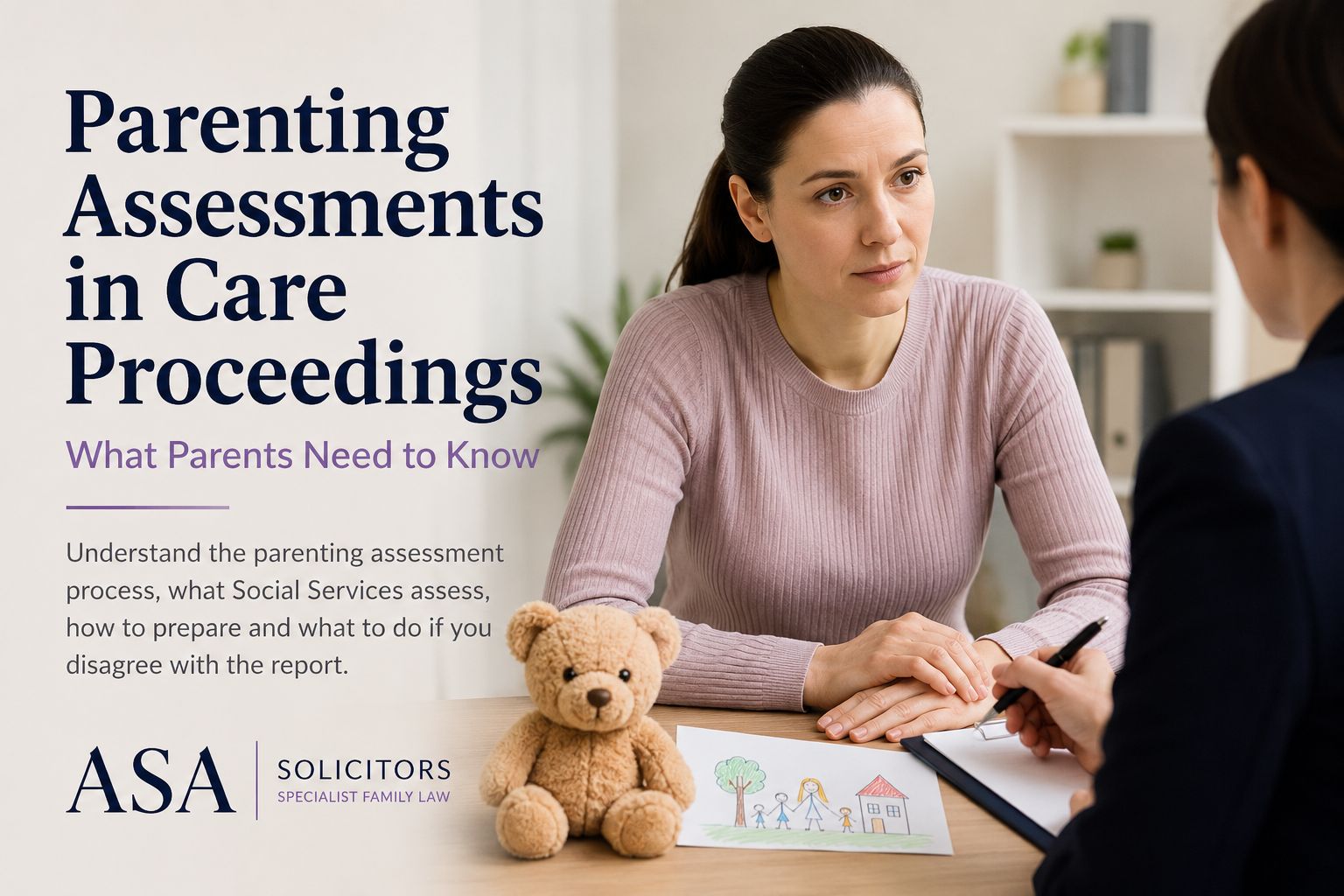
If Social Services are involved with your family, you may be asked to take part in a parenting assessment.
A parenting assessment can play an important role in care proceedings because it helps the Local Authority and the Family Court consider whether you can safely meet your child’s needs, what support may be required and what arrangements may be appropriate for your child.
Understanding the process can help you prepare and ensure your circumstances are properly considered.
What Is a Parenting Assessment?
A parenting assessment considers your ability to meet your child’s needs safely and consistently.
It is not simply a test of whether someone is a “good” or “bad” parent.
The assessment should consider:
- Your child’s individual needs
- The concerns identified by Social Services
- Your parenting strengths
- Any risks to your child
- Your understanding of those concerns
- Changes you have made
- Whether additional support could help
Parenting assessments can take place before care proceedings are issued or during proceedings.
What Does a Parenting Assessment Look At?
The exact assessment will depend on the circumstances of your case.
Common areas include:
Your Child’s Needs
The assessor may consider whether you understand and can meet your child’s physical, emotional, educational, medical and developmental needs.
Your Ability to Keep Your Child Safe
This may include concerns relating to:
- Domestic abuse
- Neglect
- Substance misuse
- Unsafe adults
- Physical harm
- Poor home conditions
- Failure to follow professional advice
Your Understanding of the Concerns
Assessors may look at whether you understand why Social Services became involved and whether you recognise any risks that have been identified.
You do not have to agree with allegations that you believe are untrue. However, where concerns have been established, your ability to understand and address those concerns may be important.
Your Ability to Make Changes
The assessment may consider whether improvements you have made are likely to continue.
For example, this could include completing relevant courses, engaging with support services, addressing substance misuse concerns or making changes within the home.
What Happens During a Parenting Assessment?
A parenting assessment will usually involve more than one meeting.
The assessor may:
- Speak to you about your background and family circumstances
- Discuss the concerns raised by Social Services
- Review court and Social Services documents
- Observe you spending time with your child
- Speak with professionals working with your family
- Consider the support available to you
In some cases, a specialist assessment may be required, for example where there are concerns involving learning difficulties, mental health, domestic abuse, substance misuse or other complex issues.
Will I Be Observed With My Child?
Often, yes.
An assessor may observe contact between you and your child.
They may consider:
- How you respond to your child’s needs
- How you manage behaviour and boundaries
- How you comfort and reassure your child
- How your child responds to you
- How you manage routines, play or feeding
The assessment should consider the overall evidence rather than relying solely on one individual contact session.
How Should I Prepare?
You should understand exactly what concerns are being assessed.
Before the assessment starts, speak to your solicitor about:
- Who is carrying out the assessment
- Why it has been requested
- What issues the assessor has been asked to consider
- How long it is expected to take
- When the report will be completed
You should engage openly with the process.
However, being cooperative does not mean that you must agree with allegations you believe are inaccurate.
Your solicitor can advise you about how to respond to disputed allegations.
What If I Have Learning or Communication Difficulties?
Tell your solicitor as early as possible.
You should be able to participate meaningfully in your assessment.
Depending on your circumstances, adjustments may be needed, including:
- Simpler written information
- Additional time
- Shorter appointments
- Communication support
- An interpreter
- A specialist assessment
Your individual needs should be properly considered.
Can I Challenge a Negative Parenting Assessment?
Yes.
A parenting assessment is evidence. It does not decide the outcome of your case.
If you disagree with the report, your solicitor can review it with you and consider whether there are:
- Factual errors
- Important evidence that has been overlooked
- Conclusions that are not supported by the evidence
- Changes you have made that have not been properly considered
- Communication or cultural misunderstandings
- Recommendations that do not take account of available support
Where appropriate, concerns can be raised with the assessor or addressed before the Family Court.
Can I Ask for an Independent Assessment?
Possibly.
A parent cannot automatically obtain another assessment simply because they disagree with the first one.
The court will consider whether any additional expert evidence is necessary to resolve the proceedings.
Your solicitor can advise you whether there are grounds to request a further or specialist assessment.
What Happens After the Assessment?
The assessor will usually prepare a written report containing their findings and recommendations.
This may include:
- Your parenting strengths
- Areas of concern
- Changes you have made
- Whether further support could help
- Recommendations about your child’s future care
You should go through the report carefully with your solicitor.
A negative assessment does not automatically mean that your child will be removed permanently.
Likewise, a positive assessment does not automatically determine the outcome.
The Family Court must consider all of the evidence and decide what arrangements are in your child’s best interests.
Speak to ASA Solicitors
ASA Solicitors represents parents and family members where Social Services are involved with children.
If you are undergoing a parenting assessment as part of care proceedings, our Family Law team can advise you about the process, review the assessment with you and represent you throughout your case.
Parents who are parties to care proceedings will generally be entitled to Legal Aid for their representation without their income or savings being assessed.
ASA Solicitors, 12 New John Street, Bradford, BD1 2QY
Telephone: 01274 900 400
Website: www.asa.co.uk
Frequently Asked Questions
What is a parenting assessment in care proceedings?
It is an assessment of whether a parent can safely and consistently meet their child’s needs. It may consider parenting ability, risk, insight, changes made and whether additional support is required.
How long does a parenting assessment take?
There is no fixed timescale. Some assessments take place over several sessions across a number of weeks.
Can I fail a parenting assessment?
Parenting assessments are not usually simple pass-or-fail tests. The assessor will consider your strengths, concerns, ability to make changes and whether support could help.
Should I agree with everything Social Services say?
No. You should engage with the assessment, but you should not agree with allegations you believe are untrue. Speak to your solicitor about any disputed issues.
Can I challenge a negative parenting assessment?
Yes. If the report contains factual mistakes, overlooks important evidence or reaches conclusions that you believe are unfair, your solicitor can advise you about challenging those issues.
Does a negative assessment mean I will lose my child?
No. A parenting assessment is only one part of the evidence. The Family Court must consider the entire case before deciding what arrangements are appropriate.
Can I get Legal Aid?
Parents who are parties to care proceedings will generally qualify for non-means-tested Legal Aid for representation. Your solicitor can confirm your individual eligibility.